Blog

  • My published complaint to the FTC about the Experian lates after charge-off or collection

    My DRAFT complaint to the FTC is posted at http://liarsandcheats.info/credit-bureau-experian-and-devry-reporting-false-late-payments-refusal-to-delete/

    I have not received a response from Experian or DeVry and I’ll snail mail everything next week to the FTC. That DeVry would DELIBERATELY destroy their former students’ credit and lives is beyond belief.   Obviously, that’s a school to be avoided at any cost.

    Very important, I also addressed Experian’s refusal to disclose when derogatory accounts will be deleted and the possibly re-aging of collections and charge-offs.

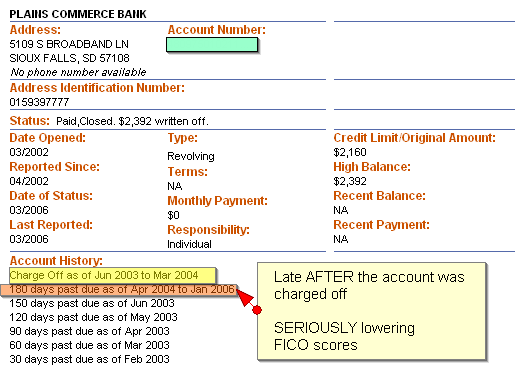
  • Experian’s LACK of reasonable procedures: lates after chargeoff

    TYPICAL Experian OBVIOUS incorrect reporting includes late payments AFTER an account was charged off.

    The Trans Union FICO score WITH this account (including an incorrect balance), 5 public records and 2 collections is 689.

    As POSITIVE TU score factor Fair Isaac lists:

    You’ve recently been paying your bills on time.

    Your most recent late payment happened 6 Years ago

    The time since the most recent late payment is CRITICAL for FICO scores and obviously the scores will be LOWER when it’s been 3 years instead of 6 years since the last delinquency.

    We can’t get the Experian FICO scores anymore (unless your mortgage lender gives you the report), but since this is the only derogatory tradeline, the Experian FICO score is at least 20 points lower than it SHOULD be.

    As always, IGNORE the totally fraudulent Experian snake oil score which is often 100 points higher or lower than the FICO scores used by creditors. In this case, the 588 “Plus” score is artificially low.

    Very FEW people would notice these BIZARRE late payments AFTER the charge-off:

    Most credit repair people will NOT notice the crucial INCORRECT data and will NOT properly dispute it.

    They write some idiotic dispute about not remembering the account or the “right” to verification under the FCRA and the creditor obviously VERIFIES because it IS the consumer’s account.

    Sure, the account could be deleted, as the credit bureaus will when a creditor doesn’t respond to the dispute on time. But the chances of deletion are identical when you dispute factually:

    “Please delete all late payments after the account was charged off.”

    If they verify and especially if it’s the most recent late payment (as in this case), you might want to sue.

    If they verify after you submitted your FRIVOLOUS or FALSE dispute, you branded yourself as a lying moron and of course you can NOT expect correction of something you didn’t dispute.

    Of course, nobody should have to dispute such OBVIOUS incorrect data.

    I’m not aware of ANY procedures by Experian or any CRA to ensure maximum accuracy of credit data.

    Any first year programmer can write a routine that automatically flags late payments after the account was charged off.

    It’s child’s play.

    Instead, the CRAs strive to report INCORRECT and INCOMPLETE FICO score lowering data.

    Incorrect credit reporting PAYS!

    The worse the credit, the greater the CRAs’ profits from sales to consumers who try to improve their credit and to creditors who turn consumers down and/or look for the profitable SUBPRIME customer.

    If the incorrect credit reporting leads to additional defaults, the CRAs make even MORE money from credit report sales to collectors.

    The credit bureaus have NO incentive to provide COMPLETE and ACCURATE credit reports.

  • Stopping payment on mortgage for investment property with negative cashflow

    Good afternoon,

    I declared bankruptcy (Chapter 7) in 2007 and did not realize that the loans with Homecomings Financial for my investment property in South Carolina have been discharged as well. Now that I am ready to attend repairing my credit, my question is this:

    I have continued making payments on that property to HF on a regular basis and have even liquidated some of my IRA money to do so. The property is cash-flow negative. What are my rights here? Could I simply no longer make the payments? What options exist?

    Thank you!

    My phone number is …

    Regarding the LEGAL RIGHTS you need to talk to your bankruptcy ATTORNEY. 

    There are many issues to consider:

    • The market value of the property.There’s negative cashflow, is that after tax and how much?
    • If the loan was discharged and there’s no chance of a deficiency judgment, you need to analyze the FINANCIAL impact and the CREDIT impact.
    • Obviously it would be better to sell the property and get a check at closing.
    • If that’s not an option and you just stop making payments, you could inform Homecomings that the loan was discharged and that they can have the property.
    • Or you could do nothing and continue to accept the RENT after you stop making payments.  Many investment property owners pocket the rent after they default on the mortgages and I don’t know the South Carolina law. Talk to your attorney.  I applaud anyone who stiffs a bank like Homecomings, but they might have legal options against you and I’d NOT spend any of the rents for a while.
      CREDIT:  Homecomings will probably report NEW derogs.  If you’re lucky, they’ll fix it after disputing with the CRAs.  One could argue that you’re keeping income from the property to be able to pay a lawyer to get the credit reporting corrected. ANYTHING could happen.  Obviously NEW derogs will destroy the scores.
    • Additionally, you’re turning a positive tradeline into a NEGATIVE tradeline even if reported correctly as discharged in 2007 and how it will effect your FICO scores depends on THE OTHER ACCOUNTS on your credit.

    I hope that helps the many people in similar situations.  Unfortunately, I don’t have an oracle and I NEVER EVER give telephone advice.  I’m a professional, not a con artist.

    Lastly, why would I work free of charge for you? 

    I’ve worked tens of thousands of hours on litigating, publishing my research and litigation and trying to get the regulators to enforce the laws and urging legislators to make sensible laws. If they had NOT ignored my 2003 federal complaint and my many submissions, we’d have NO credit crisis today.

    I worked literally 120 hrs/week for years and did all I could to help everybody, but I will not work free of charge for individuals. 

    Please read  Lenders agree: FICO scores do NOT predict defaults

    Christine

  • The extremely important Experian STATUS and DELETION dates

    (click on image for full size)

    When was this account charged off?

    How does a CREDITOR know how to rate this account?

    How does Experian determine when the account is to be deleted?

    How do FICO scores rate the account?

    Since Fair Isaac does NOT provide the DETAILS for the scores such as how many months ago an account was delinquent, I cannot prove how the account is rated.

    Experian should be ORDERED to provide the dates of the charge-off to creditors and the date of first permanent delinquency to creditors.  I’ve SUED Experian over this and the deposition is at CreditCourt.  That’s the case I had to dismiss because they filed my totally unredacted credit reports on PACER for ANYONE to download.

    To all you credit experts:

    Can you tell me when this account was charged off or when the account first became permanent delinquent?

    Can you tell me whether the scheduled deletion date is CORRECT?

    I’ll try to post how Fair Isaac reports the account soon.

  • White v. Experian et al: CRAs must update SOME discharged accounts after bankruptcy filing

    The 8/19/08 stipulated order pertains to several class action against all three CRAs.

    DRAFT: I will edit this entry after I read the order again or get some feedback from attorneys.  I am NOT an attorney (updated 10/14/08 11:03 am)

    The lead case is Terri N. White, et al. v. Experian Information Solutions, Inc.  Case No. SA CV 05-1070.

    The 8/19/08 order.

    The credit bureaus routinely failed to correctly report discharged accounts as included in bankruptcy and the order addresses some, but unfortunately not all problems with after bankruptcy reporting.

    It shows that the plaintiffs’ attorneys don’t know anything about FICO scores and they missed the opportunity to make this a truly comprehensive order.  Of course that’s good for you, the credit professional, as it means that most after bankruptcy reports will benefit from an expert’s review.

    The highlights of the order:

    1) CRAs have to report many, but not all derogatory tradelines, collections and judgments as included in bankruptcy within 60 days of reporting the bankruptcy filing.

    The CRAs had until October 1, 2008 to scrub all credit files to ensure that most dischargeable closed derogatory accounts with major derogatories (as defined) and opened before the bankruptcy discharge are reported as included in bankruptcy, with NO balances and NO new lates payments.

    2) CRAs cannot update certain dates such as the EXTREMELY important Experian status date.

    This was one of my claims against Experian in my first federal suit.  Unfortunately, I had to dismiss my entire case in exchange for the removal of my entirely unredacted credit reports from PACER, where anyone could download my reports for 8 cents/page.  [My petition for rehearing / en banc re. Experian filing my unredacted credit reports]

    I do NOT understand why Experian is allowed to report the status date as a month AFTER the discharge date.  Lawyers on drugs???

    3) Consumers retain the right to dispute accounts incorrectly reported as discharged.

    It is most important for FICO scores to have OLD positive accounts and established OPEN accounts.  Unfortunately, the CRAs have repeatedly REFUSED to remove the bankruptcy notations from mortgages and auto loans that were actually paid as agreed and NOT discharged.  The FICO scores can easily be lowered over 50 points by incorrect bankruptcy reporting.  In this order, the credit bureaus acknowledge that they know that incorrect bk reporting can be detrimental.

    4)  They FAILED to address the Trans Union Date Closed.

    Capital One is notorious for removing the date closed for discharged accounts or using a much more recent date closed.  The difference in FICO scores can exceed 80 points.

    5) Incomplete reporting is EXPLICITELY allowed.

    They explicitly ALLOW incomplete reporting of accounts without the date opened.

    6) NO liquidated damages for violations of the order.

    If they were SERIOUS about accurate reporting, we would have a clause with liquidated damages for failing to comply with the order.   After my preliminary analysis of the order, the primary benefit seems to be for lawyers in future litigation.

    7) Implementation

    September 1, 2008 with possible extensions to March 31, 2009.  I don’t know yet what the status is, have to check the docket.

    CONCLUSION

    There’s nothing exciting about this much hyped stipulated order other than to establish the POSSIBILITIES for accurate reports due to software automation.  There are SO many incorrectly reported accounts that could be automatically corrected or rejected by software.

    Quite likely MANY accounts that were NOT discharged will be reported as discharged.

    With so much more important incorrect reporting, it looks like this is a HUGE money maker for the plaintiffs’ attorneys who apparently don’t care about COMPLETE and ACCURATE reporting.  I question the ethics and/or competence of the attorneys.  Considering the NUMBER of attorneys involved, this is truly disappointing.

    Consumers will still have to spend $50/person on myFICO credit reports after the discharge.

    Consumers can wait 60 days after the discharge before ordering myFICO reports.  However, it is quite likely that disputes will need to be submitted anyway.

    I also expect the CRAs’ software to IMMEDIATELY correct discharged accounts when the bk discharge public record is reported. There is absolutely no need to delay 60 days as it is done automatically by software.  But it’s possible that they’ll program the software to wait 60 days to ensure maximum inaccuracy as long as possible.

    As always, ANALYZE the FICO score factors.

    Don’t waste your clients’ money on frivolous disputes.  It’s important to have the accounts reported as discharged and to have the correct DATES.  Do NOT dispute accurate derogatory data or other irrelevant derogatory notations such as the charge-off status.

    Consumers are experts at submitting frivolous disputes themselves and if all the IMPORTANT data is accurate, they can start disputing in hopes of getting the accidental deletions.

    Make sure that your clients understand that deletions of discharged accounts may result in LOWER scores.

    Sometimes those frivolous disputes backfire, causing accounts only on one report to be reported to all three CRAs or causing score lowering changes in the reporting.   I always annotate the clients’ derogatory accounts NOT to dispute because deletion would likely lower scores and I usually do NOT recommend frivolous disputes.  After all, it is quite likely that a credit bureau will revert to incorrect reporting, then refuses to correct and that a lawsuit has to be filed.  It is NOT helpful to have CRAs produce the frivolous disputes.

    Definitions and highlights from the 36-page order:

    (more…)
  • FCRA Section 623(a) violations do NOT result in legal claims for consumers

    A CreditFactors subscriber had been disputing with HSBC directly after reading about the “623 method” on the web. It took a while to get the point across that many provisions of the FCRA are totally useless.

    Unfortunately, there is lots of misinformation on the web about NEW RIGHTS under the 2003 FCRA amendment (FACT Act) and many credit sites recommend disputing with creditors directly.

    Many credit repair companies also send frivolous disputes directly to CREDITORS. Of course the credit repair mills don’t send disputes with the intent to sue because the disputes are frivolous and they try to delay corrections so that their clients continue to pay longer.

    However, if you are a credit professional, you are NOT sending frivolous disputes and you should know the basics about establishing legal claims for your clients.

    From the FCRA:

    § 623. Responsibilities of furnishers of information to consumer reporting agencies [15 U.S.C. § 1681s-2]

    (c) Limitation on liability. Except as provided in section 621(c)(1)(B), sections 616 and 617 do not apply to any violation of–

    (1) subsection (a) of this section, including any regulations issued thereunder;

    Section 623 (a) contains the touted new requirements for data furnishers, section 621 is “Administrative enforcement” and sections 616 and 617 are the sections giving consumers the right to sue.

    Data furnishers have absolutely NO liability to consumers for failing to comply with section 623(a) requirements.

    And that explains why creditors couldn’t possibly care less about compliance.

    ONLY regulators can enforce section 623 (a) compliance.

    Have the client mail disputes to a creditor directly if also disputing with the CRAs and the client is going to sue if the reporting is not corrected. In other words, dispute with the creditor directly if it’s important.  Since the CRAs often don’t provide the actual disputes submitted by consumers to the creditors, COMPLETE and FACTUAL disputes with creditors IN ADDITION to the CRA disputes might result in larger punitive damages or settlements. 

    Do NOT send letters to creditors because of “rights” under FCRA 623(a) as consumers have NO legal rights after violations. 

    It especially unprofessional to demand “validation” of debts from creditors and makes the client look bad.

    If it’s NOT the client’s account, have him/her send a notarized fraud affidavit.  Demanding validation indicates that the client is a liar.

    The 2003 FACT Act weakened the FCRA and added countless pages of ludicrous and bizarre requirements to confuse consumers and even lawyers.

    It makes it easy for credit bureaus and creditors to get lawsuits dismissed because consumers don’t have the right to sue for most violations.

    While the regulators COULD enforce consumer legislation, they refuse to do so.  So let’s just get rid of all that harmful fluff and stick to laws that mean something.

  • Credit bureaus and Sallie Mae REFUSE to correct student loan high credit reporting

    Every month the balances on deferred student loans increase as the deferred interest is added, but the “high credit”, “original balance”, “highest amount owed” or whatever label is on the credit reports is NOT increased. 

    Obviously, it’s NOT good for credit scores to have installment loan balances higher than the original loan amounts and FICO scoring software does NOT exclude from the installment balance/limit ratio the student loans with the notation indicating that the loan is in deferment

    When consumers dispute, the credit bureaus update with the new increased balance, but they do NOT update the “high credit”, the most owed. 

    The Experian negative score factor:

    The remaining balance on your non-mortgage installment loans is too high.

    FICO scoring software determines that you are a poor credit risk because you’re owing more on your non-mortgage installment loans than when you got the loans.

    Current balance / high credit = percentage of amount still owed.

    In this case:

    $8,779 / $6,000 = 146%

    Several clients disputed TWICE and TWICE all three credit bureaus FAILED TO CORRECT!

    The first dispute of the Sallie Mae student loans to Equifax:

    2) Sallie Mae [account # redacted] and [account # redacted] – Please correct the High Credit. It can not possibly be LOWER than the current balance.

    Equifax VERIFIED with the incorrect reporting.

    The 8/18/08 2nd dispute :

    2) You VERIFIED the OBVIOUSLY incorrect reporting of the Sallie Mae student loans with the High Credit LOWER than the current Balance.  Please advise Sallie Mae to correct the reporting and to ensure that ALL student loans are reported correctly as FICO scores are lowered by this practice. 

    The 9/9/08 Equifax investigation results:

    HUH?

    (Click on picture for larger view) 

    These two Equifax screenshots are from the SAME investigation results. 

    This is a TYPICAL example of communications with credit bureaus.

    When a client disputed with Sallie Mae directly, it responded that it was reporting accurately and it failed to correct the credit reporting. 

  • Finally: the accounts

    The account listing

    This listing is very helpful on reports with many accounts. You can quickly see the balances, open dates, status and the dreaded little red flags indicating that the account was delinquent.

    MISSING are the credit limits and high credit and whether/when the accounts were closed.

    Credit analyzing software should include this data, drop the account number and instead of a “yes/no” for lates, include the DATE of the last late.

    And of course one should be able to sort by clicking on the field name, as is standard for many programs.

    Account details

    Here’s the beef:

    While there is MORE information on the credit bureau direct report, this is the information utilized in the FICO scores.

    The student loans are INCORRECTLY reported as “unrated or bankruptcy” and SHOULD be reported as “paid as agreed.”

    Because these are the ONLY accounts, the “unrated or bankruptcy” is devastating.

    I’ll explain why once we got through this report.

  • Consumer statements on credit reports are IGNORED by most creditors

    The FCRA allows consumers to add an up to 100-word statement after the credit bureaus refused to correct / delete accounts as per the consumers disputes. 

    The credit bureaus encourage consumers to submit these statements in their investigation results, but they do NOT disclose that just about no creditor reviews the credit reports because they are using credit scores and the “magic number” determines decline, approval and terms of credit offered.

    FICO scores IGNORE consumer statements.

    Since credit scores do NOT rate these statements and almost all creditors use credit scores, adding a consumer statement to the credit report is a complete waste of time.

    It’s a lot like demonstrating at a political convention.  The protesters have to remain in a “free speech” zone where nobody hears and sees them.  Similarly, these “statements” are your right to free speech on your credit report, cleverly designed to be ignored.  You’re wasting your time and resources.

    Additionally, there can be negative side effects.

    The late payments you’re apologizing for might drop off and the statement remains.  It could be embarrassing and/or could cost you an apartment or job. 

    Now if we could only get Congress to get a clue and realize that credit scores don’t rate statements and REMOVE this fake and completely useless consumer “right”.

  • Credit At-A-Glance

    Personal Information

    • Personal data is NOT included in FICO scores.

    While it’s not necessary to ensure the accuracy of personal data, I take a quick look when working with new clients.  Usually I don’t know where my clients live, where they work and how old that are.  It helps me communicate with my clients and STATE law is important when it comes to collection issues and law suits.

    The ADDRESS is very important.

    When I draft disputes for clients, I check the CURRENT addresses on all 3 reports and about 1/3 of  clients have a report with an incorrect current address.  Usually, but not always, these are reports with no open accounts.  

    The credit bureaus will send investigation results to the address on the report and provide it to creditors for pre-approved credit offers.  

    A notice of CORRECT address has to be included with the credit bureau disputes and it’s also a good idea to include a copy of ID and a utility bill showing the new address.

    Personally, I avoid providing information to credit bureaus.  What does my drivers license number have to do with my credit?  When TU refused my disputes in 2001 and demanded ID, I immediately sued.  I didn’t ask them for a credit report, but for CORRECTION of my data.  I had even included a copy of my TU credit report with my dispute.  They should at least have started the investigation and could have sent a letter advising that I need to send ID before they’ll send me a new report.

    It’s easier, cheaper and faster to just give them what they want, especially if they already have the info, such as your current drivers license number.

    Credit bureaus also routinely refuse disputes and require ID even when the address is accurate and they recently sent investigation results to the same address.  It’s one of many ways for the credit bureaus to discourage disputes.

    There are measures consumers should take to protect their privacy.

    Never give home phone numbers or permanent cell phone numbers to creditors.  I recommend using free virtual phone numbers and PO boxes or private mail boxes for all .  Many millions of people will live a much more enjoyable life when they eventually default on their credit cards and have collectors hounding them.

    Credit at-a-glance

    Finally, some useful data.  I might have a quick look before I get to the accounts, but it’s not very relevant until after I reviewed the accounts.  If a reported mortgage doesn’t show up as mortgage in this table, there’s obviously a problem with the reporting.

    Statements

    I assume that this is the section for statements submitted by consumers to explain or dispute delinquent accounts after the credit bureaus refused to correct/delete.

    FICO scores do NOT rate consumer statements. 

    That’s why it’s pointless to submit these up to 100-word statements the credit bureaus promote when they don’t correct their reporting. 

    It’s a lot like demonstrating at a political convention.  The protesters have to remain in a “free speech” zone where nobody hears and sees them.  Similarly, these “statements” are your right to free speech on your credit report, cleverly designed to be ignored.  You’re wasting your time and resources.

    Additionally, there can be negative side effects. 

    The late payments you’re apologizing for might drop off and the statement remains.  It could be embarrassing and/or could cost you an apartment or job.  If nothing else, you certainly look stupid.

    Now if we could only get Congress to stop misleading consumers and to DELETE this fake and completely useless consumer “right”.

    If you have something to say about incorrect reporting, say it to a judge.

    The FCRA promotes these consumer statements to discourage lawsuits against creditors and credit bureaus.  The goal is to mislead consumers, falsely implying that they can mitigate the adverse effect of false credit reporting.  Only correction / deletion of the reporting will impact on the credit rating and that can best be accomplished with a lawsuit.